
Piece
Unknown Artist
17th century
Medium
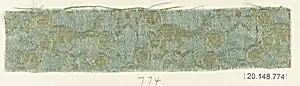
Silk / Compound weave
Dimensions
1 5/8 × 5 7/8 in. (4.1 × 14.9 cm)
Classification
Textiles-Woven
Culture
Japan
Department
Asian Art
Museum
Metropolitan Museum of Art, New York, NY
Credit
Gift of Kihei Hattori, in memory of his father, Kihei Hattori, 1920
Accession Number
20.148.774
Rights
Public Domain
Tags
Art Historical Context
This delicate silk fragment, titled simply *Piece*, hails from 17th-century Japan during the Edo period (1603–1868), a time of relative peace and flourishing craftsmanship. Woven in a compound weave technique, it measures just 1 5/8 × 5 7/8 inches, suggesting is a surviving snippet from a larger garment, such as a kosode (early kimono precursor) or accessory. Donated to the Metropolitan Museum of Art 1920 by Kihei Hattori in memory his father, it exemplifies the exquisite textiles produced in weaving centers like Nishijin in Kyoto. The compound weave method is a marvel of technical sophistication, allowing weavers to create intricate, multi-layered patterns in a single process—far more complex than plain weaving. Luxurious silk threads, dyed with natural pigments, capture motifs of animals (tagged in the collection), which in Japanese art often symbolized harmony with nature, good fortune, or folklore tales. These small-scale designs highlight the wearer's status, as silk textiles were prized for their sheen, durability, and storytelling quality. Though the artist remains unknown, this piece reflects Japan's mastery of textile arts, blending utility with artistry. Imagine it adorning a samurai's robe or a merchant's obi, whispering stories of a vibrant era. A testament to enduring elegance, it invites us to appreciate the unseen hands behind such finery. (198 words)