
Piece
Unknown Artist
18th century
Medium
Silk / Compound weave
Dimensions
5 in. × 4 3/4 in. (12.7 × 12.1 cm)
Classification
Textiles-Woven
Culture & Period
Japan · Edo period (1615–1868)
Department
Asian Art
Museum
Metropolitan Museum of Art, New York, NY
Credit
Gift of Kihei Hattori, in memory of his father, Kihei Hattori, 1920
Accession Number
20.148.813
Rights
Public Domain
Tags
Art Historical Context
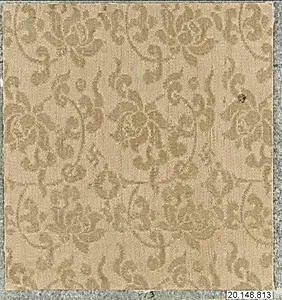
This delicate silk textile fragment, titled simply *Piece*, hails from 18th-century Japan during the Edo period (161–1868), a age of artistic refinement and urban culture. Woven in a sophisticated compound—where multiple warp and we sets interlace to form complex, textured patterns—this small work (just 5 × 4¾ inches) exemplifies the precision of Japanese textile artisans. Its floral motifs, by the tags, likely celebrate nature's beauty, a recurring theme in Edo art symbolizing impermanence and seasonal harmony. Edo-era silk weaving reached new heights of innovation, driven by prosperous merchant classes who commissioned luxurious fabrics for kimonos, furnishings, and accessories. Compound weaves like this allowed for vibrant, multi-layered designs in a single process, blending functionality with aesthetic elegance. These textiles were not mere cloth but cultural artifacts, reflecting Japan's mastery of silk production and its deep reverence for floral imagery drawn from gardens, poetry, and festivals. Generously donated to the Metropolitan Museum of Art in 1920 by Kihei Hattori in memory of his father, this intimate piece invites visitors to marvel at the hidden artistry in everyday materials, bridging centuries of craftsmanship to our modern gaze.