
Piece
Unknown Artist
18th century
Medium
Silk / Compound weave
Dimensions
13 in. × 3 3/4 in. (33 × 9.5 cm)
Classification
Textiles-Woven
Culture & Period
Japan · Edo period (1615–1868)
Department
Asian Art
Museum
Metropolitan Museum of Art, New York, NY
Credit
Gift of Kihei Hattori, in memory of his father, Kihei Hattori, 1920
Accession Number
20.148.870
Rights
Public Domain
Tags
Art Historical Context
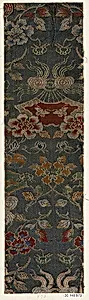
This delicate silk textile fragment, titled simply *Piece*, hails from Japan's Edo period (1615–1868), a time of relative peace and cultural flourishing under the Tokugawa shogunate. Woven using a sophisticated compound weave technique—where multiple sets of warp and weft threads create intricate, multi-layered patterns—this 13 × 3¾-inch (33 × 9.5 cm) strip exemplifies the era's mastery of luxury fabrics. Vibrant floral and leafy motifs bloom across its surface, rendered in rich colors typical of high-end silk production. In Edo Japan, textiles like this were prized for clothing, furnishings, and ceremonial uses, reflecting the society's fascination with nature's beauty and impermanence (mono no aware). Flowers and leaves, common motifs in Japanese art, symbolized seasonal cycles and elegance, often adorning kimonos or norimono (ceremonial robes). The compound weave allowed weavers to produce complex designs without embroidery, showcasing technical innovation amid growing merchant wealth and urban sophistication. A generous gift to the Metropolitan Museum of Art in 1920 by Kihei Hattori in memory of his father, this fragment offers a tangible glimpse into Japan's textile heritage, inviting us to appreciate the artistry woven into everyday opulence.