
Piece
Unknown Artist
18th century
Medium
Silk / Compound weave
Dimensions
1 3/4 × 5 3/4 in. (4.4 × 14.6 cm)
Classification
Textiles-Woven
Culture & Period
Japan · Edo period (1615–1868)
Department
Asian Art
Museum
Metropolitan Museum of Art, New York, NY
Credit
Gift of Kihei Hattori, in memory of his father, Kihei Hattori, 1920
Accession Number
20.148.935
Rights
Public Domain
Art Historical Context
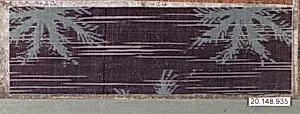
This exquisite silk fragment, woven in a compound technique during Japan's Edo period (1615–1868), offers a glimpse into the refined textile arts of 18th-century Japan. Measuring just 1¾ × 5¾ inches, this small "Piece" exemplifies the precision of Japanese weavers, who mastered compound weaving—a complex method allowing multiple layers of pattern and texture to be created simultaneously on the loom. Such techniques produced luxurious fabrics ideal for kimonos, obi sashes, and ceremonial garments, blending functionality with aesthetic splendor. The Edo era, a time of relative peace and urban prosperity under the Tokugawa shogunate, saw textiles flourish as symbols of status and craftsmanship. Silk, prized for its sheen and durability, was often sourced from regions like Nishijin in Kyoto, where guilds honed innovative looms and motifs inspired by nature, theater, or daily life. Though the artist's identity remains unknown, this piece reflects the anonymous mastery of Edo artisans, whose work influenced fashion and export trade. Today, housed in the Metropolitan Museum of Art's Asian Art Department as a gift from Kihei Hattori in 1920, it invites us to appreciate the tactile beauty of woven silk—its subtle iridescence evoking the elegance of a bygone era. A testament to Japan's enduring textile legacy, it reminds visitors how even humble fragments preserve cultural stories.