
Piece
Unknown Artist
18th century
Medium
Silk / Compound weave
Dimensions
3 3/4 × 1 5/8 in. (9.5 × 4.1 cm)
Classification
Textiles-Woven
Culture & Period
Japan · Edo period (1615–1868)
Department
Asian Art
Museum
Metropolitan Museum of Art, New York, NY
Credit
Gift of Kihei Hattori, in memory of his father, Kihei Hattori, 1920
Accession Number
20.148.951
Rights
Public Domain
Tags
Art Historical Context
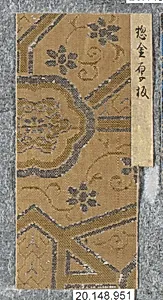
This delicate silk textile fragment, woven in a compound technique during Japan's Edo period (1615–8), exemplifies the era's mastery of intricate textile arts. Measuring just 3 3/4 × 1 5/8 inches, this small "Piece" likely served as part of a larger garment or decorative element, adorned with floral motifs that evoke the natural beauty celebrated in Japanese culture. The 18th-century date places it in a time of relative peace and prosperity, when urban centers like Edo (modern Tokyo) fostered booming industries in silk production and weaving. Compound weaving, a sophisticated method involving multiple warp and weft systems, allowed artisans to create layered, reversible patterns with vivid depth—perfect for rendering blooming flowers in rich silks. Such techniques highlighted Japan's technical prowess, rivaling ceramics and lacquerware as hallmarks of Edo craftsmanship. Flowers in these designs often symbolized seasonal change and transience (mono no aware), reflecting deeper philosophical themes. Generously gifted to the Metropolitan Museum of Art in 1920 by Kihei Hattori in memory of his father, this piece offers visitors a tangible glimpse into everyday luxury and artistic refinement of feudal Japan, reminding us how even tiny textiles carried profound cultural weight.