
Piece
Unknown Artist
18th century
Medium
Silk / Compound weave
Dimensions
4 3/8 × 4 5/8 in. (11.1 × 11.7 cm)
Classification
Textiles-Woven
Culture & Period
Japan · Edo period (1615–1868)
Department
Asian Art
Museum
Metropolitan Museum of Art, New York, NY
Credit
Gift of Kihei Hattori, in memory of his father, Kihei Hattori, 1920
Accession Number
20.148.1095
Rights
Public Domain
Tags
Art Historical Context
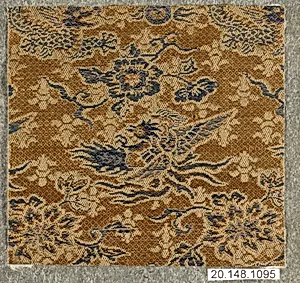
This delicate silk textile fragment from 18th-century Japan captures the refined elegance of the Edo period (1615–1868), an era when the country enjoyed relative peace and prosperity under the Tokugawa shogunate. Woven during a time when Japanese textile arts flourished for both domestic use and export, this small piece—measuring just over four inches square—likely served as a sample or decorative element in clothing or furnishings. Its intricate compound weave demonstrates the advanced silk techniques mastered by Japanese artisans, who layered multiple threads to create rich, textured patterns without the need for embroidery. The design features mythical creatures intertwined with floral motifs, a combination rich in symbolic meaning. Such imagery often evoked themes of good fortune, protection, and natural harmony, reflecting broader cultural values of the time. The use of silk underscores the material’s prestige in Japanese society, where it was reserved for high-status garments and ceremonial objects. Donated to the Metropolitan Museum of Art in 1920 by Kihei Hattori in memory of his father, this woven treasure offers visitors a glimpse into the meticulous craftsmanship and aesthetic sensibilities that defined Edo-period textile production.