
Piece
Unknown Artist
18th century
Medium
Silk / Compound weave
Dimensions
4 3/8 × 4 1/2 in. (11.1 × 11.4 cm)
Classification
Textiles-Woven
Culture & Period
Japan · Edo period (1615–1868)
Department
Asian Art
Museum
Metropolitan Museum of Art, New York, NY
Credit
Gift of Kihei Hattori, in memory of his father, Kihei Hattori, 1920
Accession Number
20.148.1098
Rights
Public Domain
Art Historical Context
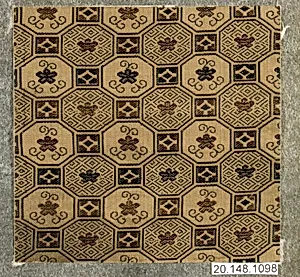
This exquisite silk textile fragment, known simply as *Piece*, hails from Japan's Edo period (1615–8), a time of peace and cultural flourishing under the Tokugawa shogunate. Measuring just 4 3/8 × 4 1/2 inches, this small woven square exemplifies the refined artistry of 18th-century Japanese textile production. During the Edo era, silk weaving reached new heights, serving not only everyday fashion like kimonos but also ceremonial garments and interior decorations, reflecting Japan's sophisticated appreciation for natural motifs and subtle elegance. Crafted in a compound weave—a complex technique where multiple layers of pattern are created simultaneously on the loom—this piece showcases the technical mastery of anonymous artisans. Compound weaving allowed for intricate, reversible designs without additional embroidery, making it prized for its efficiency and visual depth. Silk, sourced from Japan's thriving sericulture industry, provided a luxurious sheen and durability, underscoring the material's role in social status and aesthetic harmony with nature. Generously donated to the Metropolitan Museum of Art in 1920 by Kihei Hattori in memory of his father, this fragment invites us to ponder the everyday artistry of Edo Japan. Though its exact use remains a mystery, it whispers of a world where even the smallest textiles embodied profound cultural refinement.