
Piece
Unknown Artist
18th century
Medium
Silk / Compound weave
Dimensions
1 3/8 × 2 1/2 in. (3.5 × 6.4 cm)
Classification
Textiles-Woven
Culture & Period
Japan · Edo period (1615–1868)
Department
Asian Art
Museum
Metropolitan Museum of Art, New York, NY
Credit
Gift of Kihei Hattori, in memory of his father, Kihei Hattori, 1920
Accession Number
20.148.1190
Rights
Public Domain
Tags
Art Historical Context
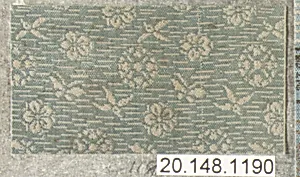
This exquisite silk fragment, woven in the 18th century during Japan's Edo period (1615–1868), offers a glimpse into the refined artistry of textile production in a time of peace and cultural flourishing. Measuring just 1 3/8 × 2 1/2 inches, this tiny "Piece" from the Metropolitan Museum of Art's Asian Art collection likely survives from a larger garment, such a kimono or obi sash, favored by the merchant class and samurai elite. Gifted in 1920 by Kihei Hattori in memory of his father, it exemplifies the era's opulent craftsmanship. Crafted using a compound weave technique—a sophisticated method where multiple layers of warp and weft create intricate, reversible patterns in a single loom pass—this silk textile showcases the technical mastery of Edo weavers. The floral motifs, delicately rendered in vibrant threads, reflect Japan's deep reverence for nature, where flowers often symbolized seasonal beauty, transience, and harmony. Such designs were not merely decorative but carried poetic resonance, evoking cherry blossoms or irises in ukiyo-e-inspired aesthetics. Though attributed to an unknown artist, this fragment highlights the anonymous yet brilliant guild traditions of Nishijin or Yuzen weaving centers in Kyoto and beyond. For visitors, it invites wonder at how such miniature luxury encapsulated Edo Japan's blend of innovation, elegance, and everyday splendor.