
Piece
Unknown Artist
17th century
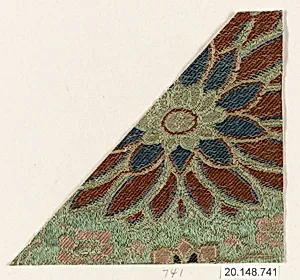
Medium
Silk / Compound weave
Dimensions
3 1/4 × 3 5/8 in. (8.3 × 9.2 cm)
Classification
Textiles-Woven
Culture
Japan
Department
Asian Art
Museum
Metropolitan Museum of Art, New York, NY
Credit
Gift of Kihei Hattori, in memory of his father, Kihei Hattori, 1920
Accession Number
20.148.741
Rights
Public Domain
Tags
Art Historical Context
This exquisite silk textile fragment, woven in the 17th century during Japan's Edo period, captures the refined artistry of that prosperous era. Measuring just 3¼ × 3⅝ inches, this small "Piece" likely served as part of a larger garment or decorative object, adorned with delicate floral motifs that evoke the natural beauty so revered in Japanese culture. Flowers, a common tag for such works, symbolized seasonal cycles, renewal, and harmony with nature—timeless themes in Edo art. Crafted using a sophisticated compound weave technique, the fabric interlaces multiple sets of warps and wefts to produce intricate, multi-layered patterns in lustrous silk. This method, perfected by Japanese weavers, allowed for rich textures and vibrant designs without relying on dyes alone, showcasing technical mastery and aesthetic elegance. Such textiles were prized for kimonos, screens, or furnishings among the merchant and samurai classes, reflecting the period's economic boom and cultural flourishing. A generous gift to the Metropolitan Museum of Art in 1920 from Kihei Hattori in memory of his father, this piece invites visitors to appreciate the subtlety of Japanese textile traditions—where every thread tells a story of innovation and impermanence.