
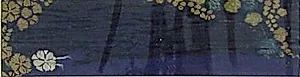
Piece from a Kosode with Incomplete Floral Pattern
Unknown Artist
Medium
Silk embroidery and traces of gold leaf on plain-weave silk
Dimensions
Sight: 1 13/16 x 7 1/16 in. (4.6 x 17.9 cm)
Classification
Textiles-Embroidered
Culture & Period
Japan · Edo period (1615–1868)
Department
Asian Art
Museum
Metropolitan Museum of Art, New York, NY
Credit
Gift of Sue Cassidy Clark, in honor of Dr. Barbara Brennan Ford, 2008
Accession Number
2008.335.12
Rights
Public Domain
Tags
Art Historical Context
This delicate fragment from a *kosode*—a Japanese under-kimono that evolved into the modern kimono—offers a glimpse into the refined textile arts of Japan's Edo period (16151868). During this era of peace and prosperity under the Tokugawa shogunate, luxurious garments became symbols of status and aesthetic sophistication, with floral motifs celebrating nature's beauty and the changing seasons. Though incomplete, the pattern hints at a larger, harmonious design, likely intended for a woman's garment worn in everyday or ceremonial life. Crafted on plain-weave silk, the piece showcases exquisite embroidery techniques, where fine silk threads create intricate floral forms, enhanced by traces of shimmering gold leaf. This combination of materials reflects the high level of artistry in Edo textile workshops, where artisans layered textures and subtle luster to evoke elegance and impermanence (*mono no aware*). The small size (just 1 13/16 x 7 1/16 inches) suggests it's a surviving remnant, preserved as a testament to Japan's masterful embroidery tradition. Displayed in the Metropolitan Museum of Art's Asian Art department, this gift honors the legacy of collectors like Sue Cassidy Clark and Dr. Barbara Brennan Ford, inviting us to appreciate the ephemeral splendor of historical fashion.