
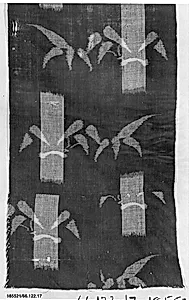
Piece of Cloth for Bedding with Pattern of Bamboo
Unknown Artist
19th century
Medium
Plain-weave cotton with warp and weft kasuri (ikat ) patterning
Dimensions
56 x 13 1/4 in. (142.2 x 33.7 cm)
Classification
Textiles-Dyed
Culture
Japan
Department
Asian Art
Museum
Metropolitan Museum of Art, New York, NY
Credit
Seymour Fund, 1966
Accession Number
66.122.17
Rights
Public Domain
Art Historical Context
This exquisite *Piece of Cloth for Bedding with Pattern of Bamboo* hails from 19th-century Japan, a time when everyday textiles blended functionality with subtle artistry. Crafted for bedding—likely as a narrow strip for futons or quilts—this plain-weave cotton panel measures 56 x 13¼ inches, reflecting the modular construction of traditional Japanese sleeping arrangements. The delicate bamboo motif evokes resilience and purity, symbols deeply rooted in Japanese culture, where bamboo bends but never breaks, mirroring life's enduring grace. The artwork's standout feature is its warp and weft *kasuri* (ikat) patterning, a sophisticated resist-dye technique. Threads were tied and dyed before weaving, creating the signature blurred, feathery edges that give ikat its ethereal quality. Mastering both warp (lengthwise) and weft (crosswise) ikat demanded exceptional skill, as misalignment could ruin the design. This labor-intensive method elevated humble cotton into wearable poetry, showcasing Japan's reverence for natural patterns and imperfection (*wabi-sabi*). Now in the Metropolitan Museum of Art's Asian Art Department (acquired via the Seymour Fund in 1966), this textile bridges domestic life and high art. It invites us to appreciate how ordinary objects carried profound aesthetic and cultural weight in Edo-period Japan, transforming a simple bed covering into a timeless treasure.