
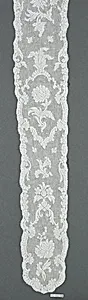
Pieced cap border with tabs
Unknown Artist
18th century
Medium
Bobbin lace
Dimensions
L. 78 1/2 x W. 1 3/4 to 4 inches (199.4 x 4.4 cm to 10.2 cm)
Classification
Textiles-Laces
Culture
French
Department
European Sculpture and Decorative Arts
Museum
Metropolitan Museum of Art, New York, NY
Credit
Henrietta Seligman Lace Collection, Bequest of Mrs. Jesse Seligman, 1910
Accession Number
10.102.59
Rights
Public Domain
Art Historical Context
This exquisite *Pieced cap border with*, crafted in 18th-century France, showcases the pinnacle of bobbin lace artistry. Measuring an impressive 78½ inches long and tapering from 1¾ to 4 inches wide this delicate textile was designed as a decorative edging women's caps or headdresses, a fashionable accessory among the European elite. Bobbin lace, made by twisting and intertwining fine threads held on small bobbins (or "pillows"), allowed lacemakers to create intricate patterns with remarkable precision—techniques that demanded years of apprenticeship and were centered in renowned French regions. Historically, such laces symbolized luxury and status during the Rococo era, when opulent textiles adorned the wardrobes of nobility. The "pieced" construction—joined sections sewn together—enabled the creation of long borders impractical to weave in one piece, highlighting the ingenuity of anonymous artisans. Its tabs likely served as ties or decorative flourishes, adding functionality to elegance. Now part of the Metropolitan Museum of Art's Henrietta Seligman Lace Collection (bequeathed in 1910), this piece preserves France's lace-making heritage, a craft that blended artistry with commerce and influenced global fashion. Visitors, imagine the soft rustle against silk as it framed a powdered coiffure at Versailles!