
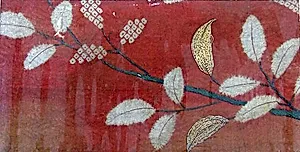
Pieces from a Kosode with Leafy Branches
Unknown Artist
Medium
Resist-dyed and painted silk satin damask (rinzu), embroidered with silk and metallic thread
Dimensions
Sight (.6): 5 1/8 x 10 3/16 in. (13 x 25.8 cm) Sight (.5): 3 13/16 x 10 1/16 in. (9.7 x 25.6 cm)
Classification
Textiles-Dyed and Embroidered
Culture & Period
Japan · Edo period (1615–1868)
Department
Asian Art
Museum
Metropolitan Museum of Art, New York, NY
Credit
Gift of Sue Cassidy Clark, in honor of Dr. Barbara Brennan Ford, 2008
Accession Number
2008.335.24a, b
Rights
Public Domain
Tags
Art Historical Context
This drawing, titled Leda and the Swan, was created by the French artist Adolphe Yvon around 1846 to 1883. It illustrates the ancient Greek myth in which Zeus assumes the form of a swan to seduce the mortal Leda, producing two children with her. Yvon's work, from 19th-century France, continues a long tradition of depicting this story in art. In the late 1520s, Michelangelo painted a version of Leda and the swan that was more erotic and sensuous than most previous treatments, making it particularly famous. Although Michelangelo's original painting was lost, several copies were made from a cartoon taken to France by one of his pupils in the 1530s. Adolphe Yvon's drawing suggests that this distinctive, sensual rendering of the subject persisted into the 1800s, showing the lasting influence of Renaissance art. Yvon employed charcoal and gouache with touches of pastel on paper measuring 39.7 by 54.5 centimeters. This mixed-media approach combines the immediacy of charcoal lines with the body and color of gouache and pastel, allowing for a richly textured composition. Bequeathed to the museum by Muriel Butkin, the piece invites visitors to explore how classical mythology inspired 19th-century creators.