
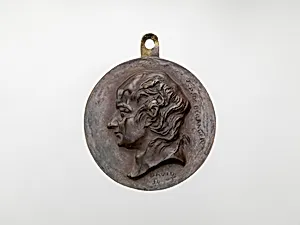
Pierre-Jean de Béranger (1780–1857)
modeled 1830, cast ca. 1830–56
Medium
Bronze
Dimensions
Overall (confirmed): 3 1/2 × 2 15/16 in. (8.9 × 7.5 cm)
Classification
Medals and Plaquettes
Culture
French
Department
European Sculpture and Decorative Arts
Museum
Metropolitan Museum of Art, New York, NY
Credit
Gift of Dr. and Mrs. Michael Schlossberg, in honor of Luke Syson, 2014
Accession Number
2014.738
Rights
Public Domain
Tags
Art Historical Context
This exquisite bronze medallion portrays Pierre-Jean de Bér (1780–1857), a beloved lyric poet renowned for his witty, satirical songs that critiqued monarchy and championed liberty. Crafted by the master sculptor Pierre-Jean David d'Angers, it was modeled in 1830—a pivotal year marked by France's July Revolution, which toppled the Bourbon restoration and ushered in the July Monarchy. David d'Angers, a leading Romantic sculptor, immortalized Béranger in profile, capturing the poet's thoughtful gaze and tousled hair in a classical yet intimate style that reflects the era's blend of heroism and humanism. As a prime example of 19th-century plaquettes and medals, this small-scale work (just 3½ × 2⅞ inches) showcases David d'Angers's virtuosity in bronze casting. He produced thousands of such portraits, distributing them widely to honor intellectuals, revolutionaries, and artists, making medallions an accessible art form for the burgeoning middle class. Cast around 1830–56, its fine detailing—evident in the subtle modeling of features and inscription—highlights the technical precision of French foundry work, turning a personal tribute into a cultural emblem of liberal ideals. On view in the Metropolitan Museum of Art's European Sculpture and Decorative Arts department, this gift from Dr. and Mrs. Michael Schlossberg honors the poetic spirit of an age of change.
About the Artist
Pierre Jean David d'Angers · 1788–1856
Pierre-Jean David d'Angers, born on March 12, 1788, in Angers, France, to a wood carver and ornamental sculptor father who had fought in the Republican army, began his artistic training locally under Marchand and Jean-Jacques Delusse at the École centrale d'Angers from 1806 to 1807. In 1808, he arrived in Paris with scant funds and entered the studio of Philippe-Laurent Roland, later working under...