
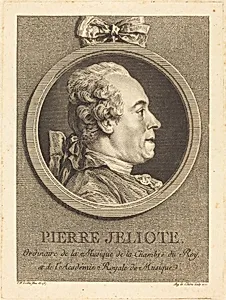
Pierre Jeliote
Medium
engraving over etching on laid paper
Dimensions
plate: 19.6 x 14.7 cm (7 11/16 x 5 13/16 in.) sheet: 27.3 x 20.2 cm (10 3/4 x 7 15/16 in.)
Classification
Department
CG-E
Museum
National Gallery of Art, Washington, D.C.
Credit
Gift of John O'Brien
Accession Number
1988.71.7
Rights
Public Domain
Art Historical Context
In the elegant world of 18th-century French theater, 1771 print captures the likeness of Pierre Jeliote a celebrated tenor, dancer, and actor who dazzled audiences at the Paris Opéra. Created by engraver Augustin de Saint-A after a design by the renowned Charles-Nicolas Co II—one of Louis XV's official artists—this portrait exemplifies the era's fascination with cultural luminaries. Cochin II, a master of Rococo ornamentation transitioning toward Neoclassicism, provided the fluid, expressive original composition, while Saint-Aubin faithfully reproduced it, making celebrity imagery accessible beyond elite circles. The medium—engraving over etching on laid paper—highlights innovative printmaking techniques of the time. Etching allowed for spontaneous, painterly lines in the initial stages, refined by precise engraving for intricate details like Jeliote's powdered wig, expressive features, and theatrical pose. Measuring a modest plate size of 19.6 x 14.7 cm, this intimate work was ideal for collectors' albums or salon walls, democratizing art during the Enlightenment. Housed in the National Gallery of Art as a gift from John O'Brien (Department CG-E), it reflects printmaking's role in preserving the glamour of pre-Revolutionary France.