
Pierre Mignard
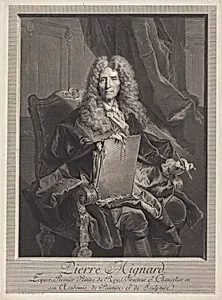
Medium
engraving on laid paper
Dimensions
plate: 51.9 x 38 cm (20 7/16 x 14 15/16 in.) sheet: 53 x 39.2 cm (20 7/8 x 15 7/16 in.)
Classification
Department
CG-E
Museum
National Gallery of Art, Washington, D.C.
Credit
Ailsa Mellon Bruce Fund
Accession Number
2007.119.1
Rights
Public Domain
Art Historical Context
This elegant engraving, titled *Pierre Mignard*, the likeness of the renowned French Baroque painter Pierre Mignard1612–1695), a leading figure in 17th-century French art. Created in 1744 by Germanaver Georg Friedrich Schmidt after original portrait by Hyac Rigaud—one of the era's premier portraitists—this print preserves Mignard's dignified presence for posterity.ud, celebrated for his royal portraits at Versailles, masterfully conveyed status and character, and Schmidt's meticulous reproduction honors that legacy. Measuring nearly 52 x 38 cm on the plate, the work is executed in engraving on laid paper, a technique where fine lines are incised into a copper plate with a burin, inked, and pressed onto paper to create rich tonal contrasts and intricate details. Laid paper, with its visible chain lines, was a hallmark of high-quality 18th-century prints, prized for its durability and texture. Such reproductive engravings were vital in the Rococo period, democratizing access to masterpieces by disseminating images of great artists across Europe. Acquired through the Ailsa Mellon Bruce Fund for the National Gallery of Art's collection, this print exemplifies the artistic exchange between France and Germany, bridging generations and underscoring engraving's role in art history's visual canon. Visitors will appreciate its technical precision and the glimpse it offers into the interconnected world of portraiture.