
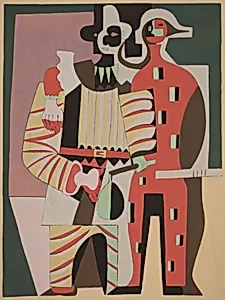
Pierrot and Harlequin
Medium
color pochoir on wove paper
Dimensions
image: 25.3 x 18.9 cm (9 15/16 x 7 7/16 in.) sheet: 39.3 x 30.3 cm (15 1/2 x 11 15/16 in.)
Classification
Department
CG-W
Museum
National Gallery of Art, Washington, D.C.
Credit
Gift of Lisa Travers, William O'Reilly, N.Y., in honor of Jacob Kainen
Accession Number
1998.122.1
Rights
Public Domain
Art Historical Context
**Pierrot and Harlequin** is a vibrant color pochoir print after Pablo Picasso, created around 1920. These iconic figures from the commedia dell'arte tradition—Pierrot the wistful clown and Harlequin the mischievous acrobat—were recurring motifs in Picasso's oeuvre, symbolizing themes of melancholy, performance, and human emotion. By this time, Picasso had transitioned from Cubism into a neoclassical phase, yet his playful yet poignant depictions of these characters echoed his earlier Rose Period explorations of circus life and vulnerability. The pochoir technique, a meticulous stencil-based method for layering vivid colors by hand, was prized in the early 20th century for reproducing paintings with painterly richness on wove paper. This medium allowed for the flat, bold hues and precise edges that enhance the print's theatrical drama, measuring a compact 25.3 x 18.9 cm in its image area. As a fine art print, it democratized access to Picasso's vision during the interwar avant-garde boom. Generously gifted to the National Gallery of Art by Lisa Travers, William O'Reilly, and others in honor of Jacob Kainen, this work exemplifies Picasso's enduring influence on printmaking and performance-inspired art, inviting visitors to ponder the timeless allure of these masked entertainers.