
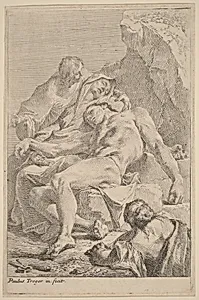
Pietà
1720s
Medium
etching on laid paper
Dimensions
plate: 19.4 x 12.7 cm (7 5/8 x 5 in.) sheet: 19.9 x 12.9 cm (7 13/16 x 5 1/16 in.)
Classification
Department
CG-E
Museum
National Gallery of Art, Washington, D.C.
Credit
Gift of The Ahmanson Foundation
Accession Number
1999.98.13
Rights
Public Domain
Art Historical Context
In the hushed galleries of the National Gallery of Art, Paul Troger's *Pietà* (1720s) captures the profound sorrow of the Virgin Mary cradling the lifeless body of Christ—a timeless motif in Christian art that reached new emotional heights during the Baroque era. Austrian artist Paul Troger, a master of dramatic frescoes and altarpieces, infused this intimate etching with the swirling energy and theatrical pathos characteristic of Baroque style. Created amid the Catholic Counter-Reformation's fervor, the work reflects the period's emphasis on vivid piety, inviting viewers to contemplate divine suffering. Etched on laid paper—a traditional support with its distinctive chain lines visible under light—this print measures a modest plate of 19.4 x 12.7 cm, making it perfectly suited for personal devotion or study. Troger's etching technique, involving acid-etched lines on a metal plate for rich tonal depth and fluid lines, allowed precise rendering of Mary's anguished expression and Christ's limp form. Far from monumental painting, this reproducible medium democratized high art, spreading Baroque grandeur to wider audiences. A generous gift from The Ahmanson Foundation to the National Gallery's Prints department, *Pietà* exemplifies Troger's versatility and enduring legacy in 18th-century European art, blending technical finesse with heartfelt spirituality.
About the Artist
Paul Troger · 1698–1762
Austrian painter. Comment on works: Religious