
Pietà
Jean-Baptiste Carpeaux, 1864
About this artwork
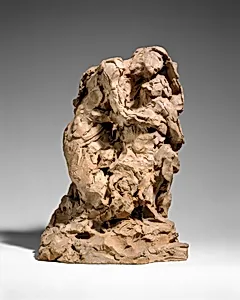
Jean-Baptiste Carpeaux'sPietà* (1864), a poignant terracotta sculpture, captures the timeless Christian theme of the Virgin Mary cradling the lifeless of Christ. Measuring just over 11 inches tall, this intimate work exemplifies the emotional depth Carpeaux infused into his neoclassical forms, blending idealized anatomy with raw, Romantic expressiveness. Created in Paris during the Second Empire, it reflects the era's fascination with religious subjects amid grand public monuments. As a leading sculptor of his time, Carpeaux renowned for dynamic figures like those on the Paris Opéra façade. Terracotta, a malleable clay fired at low temperatures, was ideal for rapid modeling—often used for preliminary studies or *bozzetti*. Here, its textured surface preserves the artist's fingerprints and tool marks, revealing the immediacy of his creative process and the sculpture's devotional intensity. Housed in the Metropolitan Museum of Art's European Sculpture and Decorative Arts department, this *Pietà* invites visitors to contemplate maternal grief and sacrifice. A gift honoring Ignazio Peluso, it stands as a testament to Carpeaux's mastery in evoking profound human emotion through humble materials.