
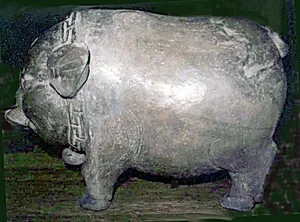
Piggy Bank
Unknown Artist
15th century
Medium
Terracotta
Dimensions
H. 10 3/4 in. (27.3 cm); W. 8 1/4 in. (21); L. 15 1/2 in. (39.4 cm)
Classification
Sculpture
Culture & Period
Indonesia (Java) · Eastern Javanese period
Department
Asian Art
Museum
Metropolitan Museum of Art, New York, NY
Credit
Anonymous Gift, 1990
Accession Number
1990.179
Rights
Public Domain
Tags
Art Historical Context
Nestled in the Metropolitan Museum of Art's Asian collection, this charming terracotta *Piggy Bank* from15th-century Java offers a delightful glimpse into everyday life during the Eastern Javanese period. Crafted by an unknown artist, the sculpture measures 10¾ inches high, 8¼ inches wide, and 15½ inches long, its plump, pig-shaped form rendered in earthy red clay. Terracotta, a fired clay medium prized for its durability and accessibility, was widely used in Java for both ceremonial and utilitarian objects, allowing artisans to capture lifelike details through hand-modeling and simple incising techniques. The Eastern Javanese period (roughly 13th–16th centuries), dominated by the Hindu-Buddhist Majapahit Empire, produced grand temple sculptures and reliefs, but this rare domestic artifact highlights the artistry of ordinary households. Piggy banks like this—known locally as *celengan*—served a practical purpose: a slot on top allowed coins to be inserted but not easily retrieved, encouraging thrift. The pig motif, echoed in the tags, may symbolize prosperity or abundance in Javanese folklore, blending whimsy with fiscal wisdom. As an anonymous gift to the Met in 1990, this piece bridges elite temple art and vernacular craft, reminding us that Javanese creativity thrived in the familiar. Visitors will appreciate its tactile warmth and humorous appeal, a testament to how ancient savings habits endure.