
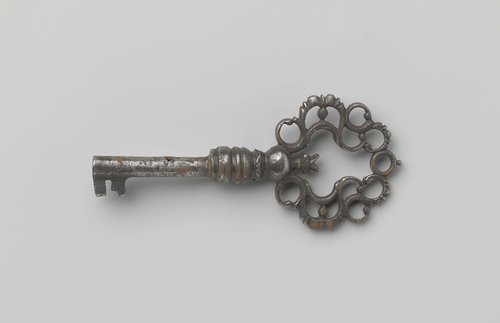
Pijpsleutel
Unknown Artist
ca. 1700 - ca. 1750
Medium
iron (metal)
Dimensions
7.6; 3.4
Rights
Public Domain
About this artwork
Bruikleen van het Koninklijk Oudheidkundig Genootschap
Art Historical Context
### Pijpsleutel (ca. 1700–1750) This compact iron *pijpsleutel*, or pipe key, dating to around 1700–1750, is a humble yet fascinating artifact from everyday life in early modern Europe. Measuring just 7.6 cm long and 3.4 cm wide, it served as a practical tool for cleaning the stems of clay tobacco pipes, which were ubiquitous during the height of pipe-smoking culture. Forged from sturdy iron, its simple, functional design reflects the utilitarian craftsmanship of the period, likely produced in the Netherlands or a neighboring region where tobacco use exploded after its introduction from the Americas in the 17th century. The object captures a slice of social history: pipe smoking became a widespread pastime among all classes, from sailors to merchants, fostering communal rituals in taverns and homes. Artisans crafted these keys in basic T- or key-like shapes to scrape out residue, ensuring pipes remained usable despite their fragile, often disposable nature. Though unsigned by a known artist, its survival highlights the value placed on even modest metalwork. On loan from the Koninklijk Oudheidkundig Genootschap (Royal Archaeological Society), this *pijpsleutel* invites us to ponder the intimate habits of the past, bridging the gap between utility and cultural tradition in a pre-industrial world.