
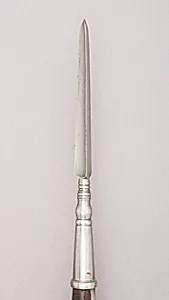
Pike
Unknown Artist
16th century
Medium
Steel, wood (ash)
Dimensions
L. 85 1/4 in. (216.5 cm); L. of head 12 1/2 in. (31.8 cm); W. 1 in. (2.5 cm); Wt. 3 lbs. 9.1 oz. (1618.8 g)
Classification
Shafted Weapons
Culture
German, Saxony
Department
Arms and Armor
Museum
Metropolitan Museum of Art, New York, NY
Credit
Gift of William H. Riggs, 1913
Accession Number
14.25.234
Rights
Public Domain
Art Historical Context
This imposing 16th-century pike from Saxony, Germany, exemplifies the formidable shafted weapons that defined Renaissance warfare. Measuring an impressive 85¼ inches (216.5 cm) in length, with a steel head 12½ inches (31.8 cm) long, it was designed for massed infantry formations. Saxon soldiers, often part of the Holy Roman Empire's armies, wielded such pikes in dense phalanxes to repel cavalry charges, playing a pivotal role in battles like those of the Italian Wars and the Schmalkaldic War. Crafted from durable ash wood for the shaft and tempered steel for the leaf-shaped head, this pike weighs just over 3½ pounds (1618.8 grams), balancing heft with maneuverability for prolonged combat. The anonymous German armorer's skill is evident in the precise forging and tapering, ensuring lethal penetration while minimizing weight—a testament to Saxon metalworking prowess amid the era's military innovations. A generous gift from William H. Riggs in 1913, this artifact now resides in The Metropolitan Museum of Art's Arms and Armor Department, offering visitors a tangible link to the grit and ingenuity of early modern Europe.