
Pilgrim's Badge
Unknown Artist
14th–16th century
Medium
Lead
Dimensions
Overall: 1 1/16 x 11/16in. (2.7 x 1.8cm)
Classification
Metalwork-Lead
Culture
French
Department
The Cloisters
Museum
Metropolitan Museum of Art, New York, NY
Credit
The Cloisters Collection, 1977
Accession Number
1977.240.74
Rights
Public Domain
Tags
Art Historical Context
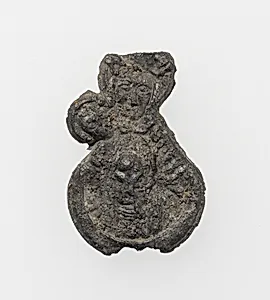
This delicate lead pilgrim's badge, in France between the 14th and 16th centuries, measures just 1 1/16 x 11/16 inches, small enough to be pinned to a traveler's cloak or hat. Depicting the Madonna and Child—a cherished motif in medieval Christian devotion—it exemplifies the humble metalwork produced for pilgrims journeying to holy sites. Housed in The Cloisters at the Metropolitan Museum of Art (The Cloisters Collection,1977), it offers a tangible glimpse into everyday piety during the late Middle Ages. Pilgrimage badges like this one served as souvenirs and protective talismans, purchased at shrines to commemorate spiritual quests and signal the wearer's faith. Lead was the ideal medium: affordable, lightweight, and malleable for mass production via molds, allowing intricate details like the tender embrace of mother and child to be replicated widely. French artisans excelled in such devotional objects, blending functionality with subtle artistry. Though anonymous, the badge's survival underscores the era's vibrant culture of mobility and devotion, where even the poorest could carry sacred imagery. A quiet testament to faith's enduring reach, it invites us to imagine the weary pilgrim's pride in wearing it home.