
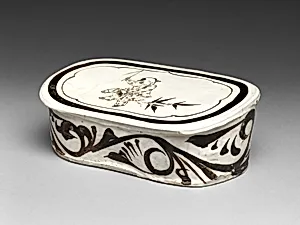
Pillow with boy on hobbyhorse
12th–13th century
Medium
Stoneware painted with brown and black pigment over white slip under clear glaze (Cizhou ware)
Dimensions
H. 4 in. (10.2 cm); W. 7 1/4 in. (18.4 cm); L. 11 1/4 in. (28.6 cm)
Classification
Ceramics
Culture & Period
China · Jin dynasty (1115–1234)
Department
Asian Art
Museum
Metropolitan Museum of Art, New York, NY
Credit
Harris Brisbane Dick Fund, 1960
Accession Number
60.73.2
Rights
Public Domain
Tags
Art Historical Context
This charming pillow from the Jin dynasty (1115–1234) was crafted in the renowned Cizhou kilns of northern China by the Zhang family workshop. Made of stoneware with brown and black pigments painted over white slip and covered in a clear glaze, it exemplifies the lively folk-art spirit of Cizhou ware. These ceramics were popular for everyday household items, transforming functional objects into delightful works of art that brought color and narrative into people’s homes. The decoration shows a young boy astride a hobbyhorse, a classic toy that captures the playful energy of childhood. Such imagery reflects the cultural appreciation for innocence and joy during a time of political division in China, when northern regions were under Jin rule. The pillow’s compact size—roughly the length of a forearm—suggests it may have served both as a headrest and a treasured decorative piece. Cizhou potters were masters at creating expressive designs with simple tools and slips, making art accessible beyond the imperial court. This example, now in the Metropolitan Museum of Art, invites viewers to appreciate how ordinary objects could carry warmth and storytelling across centuries.