
Pin
Unknown Artist
7th century
Medium
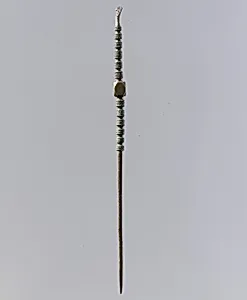
Copper alloy, "tinned" surface
Dimensions
Overall: 8 1/16 x 5/16 in. (20.4 x 0.8 cm)
Classification
Metalwork-Copper
Culture
Frankish
Department
Medieval Art
Museum
Metropolitan Museum of Art, New York, NY
Credit
Gift of J. Pierpont Morgan, 1917
Accession Number
17.192.243
Rights
Public Domain
Art Historical Context
This elegant 7th-century Frank pin, crafted from copper alloy with a "tinned" surface, a glimpse into the daily lives of early medieval Europeans. Measuring just over 8 inches long and at a third of an inch wide, it likely served as a practical fastener for clothing or cloaks, blending utility with subtle adornment. The tinning—coating the copper alloy with a thin layer of tin— a bright, silvery sheen that mimicked more precious metals like silver, making fine accessories accessible to a broader range of people. Hailing from the Frankish culture during the Merovingian period (roughly 481–751 CE), this pin reflects the sophisticated metalworking traditions of post-Roman Gaul, now modern-day France and Germany. The Franks, under kings like Clovis, forged a powerful kingdom that bridged late antiquity and the Middle Ages, and such objects highlight their skilled artisans who traded techniques across Europe. Preserved in the Metropolitan Museum of Art's Medieval Art collection through a 1917 gift from J. Pierpont Morgan, this unassuming pin underscores the artistry in everyday items. It reminds us how humble metalwork preserved cultural identity amid societal shifts, inviting us to appreciate the ingenuity of anonymous makers from 1,300 years ago.