
Pin
Unknown Artist
7th century (?)
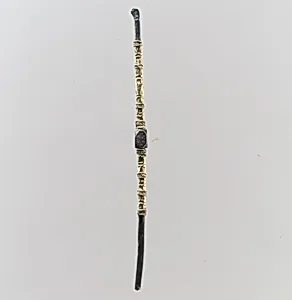
Medium
Silver, niello, gold sheet, filigree
Dimensions
Overall: 5 7/8 x 1/4 in. (15 x 0.7 cm)
Classification
Metalwork-Silver
Culture
Frankish
Department
Medieval Art
Museum
Metropolitan Museum of Art, New York, NY
Credit
Gift of J. Pierpont Morgan, 1917
Accession Number
17.192.244
Rights
Public Domain
Art Historical Context
This exquisite Frankish pin, dating to the 7th (?), exemplifies the masterful metalworking of early medieval Europe. Crafted from silver with niello inlays—a technique that creates striking black contrasts against the metal—along with delicate gold sheet and intricate filigree, the pin measures a slender 5 7/8 x 1/4 inches (15 x 0.7 cm). Likely used as a dress or cloak fastener, it reflects the Frankish people's blend of Roman influences and emerging Germanic artistry during the Merovingian era, a time when the Franks dominated much of western Europe under kings like Clovis and his successors. The pin's techniques highlight the era's technical sophistication: filigree involved twisting fine gold wires into ornate patterns, while niello provided durable, glossy decoration often depicting motifs like animals or interlace. Such objects were status symbols for elites, showcasing wealth and piety in a Christianizing society. Donated to the Metropolitan Museum of Art in 1917 by J. Pierpont Morgan, this rare survivor offers a glimpse into daily life and luxury craftsmanship from a turbulent age of migration and kingdom-building.