
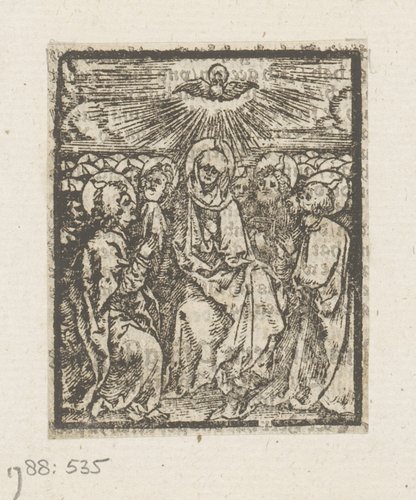
Pinksteren
Medium
paper
Dimensions
52; 63
Rights
Public Domain
About this artwork
houtsnede met tekst in boekdruk op het verso
Art Historical Context
### Pinksteren (Pentecost), 1536 Step into the vibrant world of16th-century Northern European religious art with *Pinksteren*, an woodcut print measuring a petite 63mm by 52mm. Created in 1536, this work on paper captures the biblical scene of Pentecost, when the Holy Spirit descended upon apostles as tongues of fire, a pivotal moment in Christian tradition symbolizing the birth of the Church. Its small scale hints at its likely use as a devotional aid or book illustration, making sacred imagery accessible to everyday believers during the Reformation era. The technique is a hallmark of the time: a *houtsnede* (woodcut), where the artist carved the image in relief on a woodblock, inked it, and pressed it onto paper. Flanking the verso is text in *boekdruk* (letterpress), printed with movable type—a revolutionary method pioneered by Gutenberg decades earlier. This combination allowed for efficient, affordable production of prints blending image and scripture, fueling the spread of religious narratives amid rising literacy and Protestant fervor in the Low Countries. Though anonymous, *Pinksteren* exemplifies the era's bold graphic style, with stark contrasts and expressive lines that convey divine energy in miniature form. A testament to craftsmanship, it invites us to ponder how such tiny treasures brought heavenly drama into humble homes, bridging art, faith, and the dawn of print culture. (198 words)