
Pipe
c. 1936
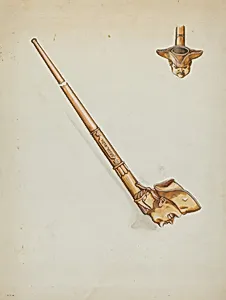
Medium
watercolor, graphite, and gouache on paper
Dimensions
overall: 35.8 x 26.7 cm (14 1/8 x 10 1/2 in.)
Classification
Index of American Design
Department
CG-W
Museum
National Gallery of Art, Washington, D.C.
Credit
Index of American Design
Accession Number
1943.8.2233
Rights
Public Domain
Art Historical Context
Mabel Ritter's *Pipe* (c. 1936) is a captivating watercolor, graphite, and gouache on paper, measuring 35.8 x 26.7 cm. Created as part of the Index of American Design—a monumental Federal Art Project under the Works Progress Administration (WPA) during the Great Depression—this work exemplifies the era's effort to document and celebrate America's rich folk art heritage. Ritter, one of many talented artists commissioned for the project, meticulously captured the intricate details of this everyday object, likely a traditional tobacco pipe, highlighting its craftsmanship and cultural resonance in American life. The Index of American Design, active from 1935 to 1942, produced over 15,000 watercolor plates to preserve vanishing examples of decorative arts, from quilts to tools. Ritter's piece showcases the project's artistic techniques: graphite for precise outlines, watercolor and gouache for vibrant yet subtle color layering, evoking the pipe's wood grain, carvings, and patina with lifelike accuracy. This medium allowed for both documentary fidelity and aesthetic appeal, bridging fine art and historical record. Today, housed in the National Gallery of Art's collection, *Pipe* invites visitors to appreciate how ordinary objects embody cultural stories—stories of ingenuity, tradition, and resilience amid economic hardship. It's a window into 1930s America, where art served both preservation and patriotism.