
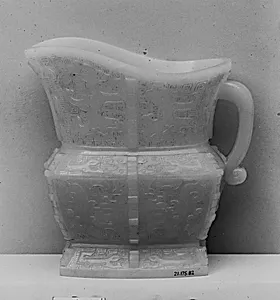
Pitcher
Unknown Artist
Medium
Nephrite
Dimensions
H. 5 in. (12.7 cm); L. 5 in. (12.7 cm)
Classification
Jade
Culture & Period
China · Qing dynasty (1644–1911), Qianlong period (1736–95)
Department
Asian Art
Museum
Metropolitan Museum of Art, New York, NY
Credit
Bequest of Edmund C. Converse, 1921
Accession Number
21.175.82
Rights
Public Domain
Art Historical Context
This elegant nephrite jade pitcher, crafted during China's Qing dynasty Qianlong period (1736–95), exemplifies the imperial era's mastery of jade carving. Standing at 5 inches (12.7 cm) in both height and length, its compact form suggests it served as a functional vessel—perhaps for wine or water—while doubling as a luxurious decorative object. Nephrite, a tough, translucent variety of jade revered in Chinese culture for its associations with purity, immortality, and moral virtue, sourced from distant regions like Xinjiang and meticulously shaped by skilled artisans. The Qianlong emperor, a passionate collector and patron of the arts, oversaw imperial workshops that elevated jade craftsmanship to new heights. Techniques involved precise cutting, intricate incising, and polishing to achieve a luminous, glassy surface that highlights the stone's natural green hues and subtle veining. Such pieces were symbols of refinement and status, often produced for the court or elite collectors. Today, this pitcher graces the Metropolitan Museum of Art's Asian Art collection, thanks to the 1921 bequest of Edmund C. Converse. It invites visitors to appreciate the enduring allure of Chinese jade, bridging artistry and cultural reverence across centuries.