
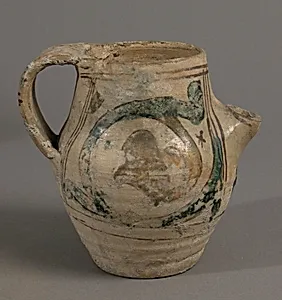
Pitcher
Unknown Artist
14th century
Medium
Earthenware, tin-glaze (Majolica)
Dimensions
Overall: 5 3/16 x 5 1/2 x 4 1/4 in. (13.1 x 13.9 x 10.8 cm)
Classification
Ceramics
Culture
Italian
Department
Medieval Art
Museum
Metropolitan Museum of Art, New York, NY
Credit
Gift of Wilhelm Bode, 1911
Accession Number
11.163.5
Rights
Public Domain
Art Historical Context
This unassuming yet elegant 14th-century pitcher, crafted from earthenware coated in tin-glaze (known as Majolica), exemplifies the artistry of medieval ceramics. Standing just over 5 inches tall, compact form—measuring 5 3/16 x 5 1/2 x 4 1/4 inches—suggests it was designed for everyday use, perhaps serving wine or water in a household setting. The tin-glaze technique, a hallmark of Italian pottery during this period, created a smooth, opaque white surface ideal for vibrant painted decorations, transforming humble clay into durable, colorful vessels. In late medieval Italy, Majolica production flourished in workshops across regions like Tuscany and Umbria, bridging Islamic ceramic traditions imported via Spain and the innovative spirit of Europe's emerging Renaissance. Though the artist remains unknown, this pitcher reflects the era's blend of functionality and subtle ornamentation, often featuring motifs like geometric patterns or foliage that hinted at prosperity. Such pieces were prized not just for utility but as status symbols in dining rituals. A generous gift to the Metropolitan Museum of Art from Wilhelm Bode in 1911, this survivor of centuries offers a tangible glimpse into daily life during a transformative time in Italian culture, when pottery began rivaling finer metals in household prestige.