
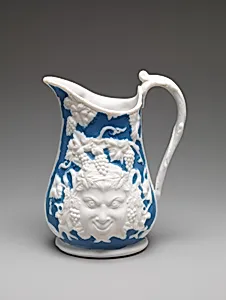
Pitcher
Unknown Artist
1830–70
Medium
Parian porcelain
Dimensions
4 7/8 x 4 x 3 9/16 in. (12.4 x 10.2 x 9 cm)
Classification
Pitcher
Culture
American
Department
The American Wing
Museum
Metropolitan Museum of Art, New York, NY
Credit
Gift of Dr. Charles W. Green, 1947
Accession Number
47.90.79
Rights
Public Domain
Tags
Art Historical Context
Nestled in the Metropolitan Museum of Art's American Wing, this delicate *Pitcher* (1830–70) exemplifies-19th-century American in Parian porcelain. Measuring just 4 7/8 x 4 x 3 9/16 inches, its petite scale made it ideal for table service or as a decorative accent in Victorian homes. Produced by an unknown artist, piece reflects the era's booming ceramics industry, where American potters emulated European finesse. Parian porcelain, unglazed and biscuit-fired for a soft, matte finish resembling Parian marble from the Greek island of Paros, gained popularity in the 1840s–70s. It allowed makers to create luminous, neoclassical forms without the sheen of traditional china, bridging utility and artistry. This American example highlights how U.S. factories, inspired by British and French models, elevated everyday objects into sculptural treasures. The pitcher's motifs—playful masks and clusters of grapes—evoke classical antiquity and Bacchic revelry, symbolizing abundance, wine, and festivity. Gifted to the Met in 1947 by Dr. Charles W. Green, it offers a glimpse into the refined tastes of antebellum America, where such wares graced parlors and symbolized prosperity. A true gem for any visitor's imagination!