
Plaque
Unknown Artist
8th–9th century
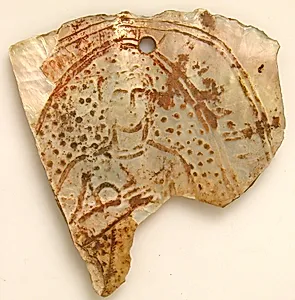
Medium
Mother-of-pearl, polychromy
Dimensions
Overall: 2 5/8 x 2 1/2 x 1/16 in. (6.6 x 6.3 x 0.2 cm)
Classification
Sculpture-Miniature
Culture
Coptic
Department
Medieval Art
Museum
Metropolitan Museum of Art, New York, NY
Credit
Gift of Richard Ettinghausen, in honor of Kurt Weitzmann, 1976
Accession Number
1976.406
Rights
Public Domain
Art Historical Context
This exquisite miniature plaque, crafted by an unknown Coptic artist in the 8th–9th century, exemplifies the refined artistry of early medieval Egypt. Measuring just 2⅝ × 2½ inches and a mere 1/16 inch thick, it is a delicate sculpture formed from mother-of-pearl—a lustrous material sourced from seashells, prized for its iridescent shimmer and workability. The addition of polychromy, or colorful pigments, enhances its surface with vibrant hues, a technique that brought life to Coptic religious and decorative objects during a time when Christianity flourished amid cultural transitions in the region. Coptic art, rooted in Egypt's Christian communities from late antiquity through the early Islamic era, often featured such intimate carvings for liturgical items, reliquaries, or personal devotionals. Mother-of-pearl plaques like this one highlight the Copts' mastery of micro-scale sculpting, where intricate details could be incised or inlaid to convey spiritual symbolism. Though its exact iconography remains unspecified, its survival speaks to the enduring value placed on these portable treasures. Now housed in the Metropolitan Museum of Art's Medieval Art Department—thanks to a 1976 gift honoring scholar Kurt Weitzmann—this plaque invites visitors to marvel at the ingenuity of anonymous artisans whose work bridged Byzantine, Islamic, and indigenous traditions.