
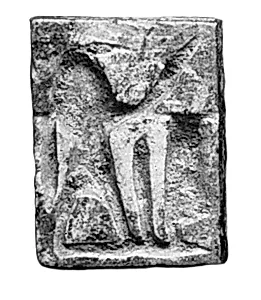
Plaque
Unknown Artist
ca. 1550–1070 B.C.
Medium
Brigth green faience
Dimensions
L. 2.2 × W. 1.7 × H. 0.8 cm (7/8 × 5/8 × 5/16 in.)
Classification
Plaque
Period
New Kingdom
Department
Egyptian Art
Museum
Metropolitan Museum of Art, New York, NY
Credit
Rogers Fund and Edward S. Harkness Gift, 1922
Accession Number
22.1.566
Rights
Public Domain
Tags
Art Historical Context
This delicate plaque, crafted from bright green faience around 1550–1070 B.C. during Egypt's New Kingdom (Dyn 18–20), the era's mastery of small-scale luxury objects. Measuring just 2.2 × 1.7 × 0.8 cm, it likely served as an amulet or decorative inlay, evoking the lush hues of the Nile Valley. Faience, a composite of quartz, lime, copper for its vivid turquoise-green tint, was prized for its jewel-like sheen and symbolic ties to fertility and rebirth—perfect for personal talismans worn by all social classes. Associated with scarabs, these plaques often mimicked the sacred dung beetle, emblem of the sun god Khepri, who rolled the sun across the sky like a ball of dung, representing renewal and protection in the afterlife. The New Kingdom, a golden age of pharaohs like Hatshepsut and Ramesses II, saw such items mass-produced yet exquisitely detailed, blending artistry with spirituality. Techniques involved molding the friable paste, firing it low, and applying a glossy glaze that has endured millennia. Acquired through the Rogers Fund and Edward S. Harkness Gift in 1922, this piece at the Metropolitan Museum of Art invites us to ponder ancient Egyptians' intimate connection to eternity—slipped into wrappings or jewelry, it whispered promises of resurrection.