
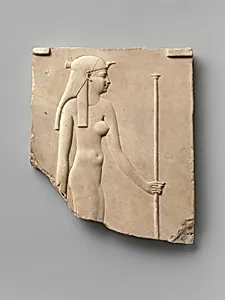
Plaque depicting a goddess, king on opposite side
Unknown Artist
400–200 B.C.
Medium
Limestone
Dimensions
H. 22 cm (8 11/16 in.); W. 18 cm (7 1/16 in.); D. 2.3 cm (7/8 in.)
Classification
Sculptor's Model, Goddess, King on reverse
Period
Late Period–Ptolemaic Period
Department
Egyptian Art
Museum
Metropolitan Museum of Art, New York, NY
Credit
Rogers Fund, 1907
Accession Number
07.228.3
Rights
Public Domain
Tags
Art Historical Context
This intriguing limestone plaque, created between 400 and 200 B.C. during Egypt’s Late Period to Ptolemaic era, captures the enduring relationship between divine and royal authority. Measuring just 22 centimeters high, the double-sided relief a goddess on one face and a king on the other, a format that likely served ritual or votive purposes. Such objects were common in temple settings, where they reinforced the pharaoh’s role as intermediary between the gods and the people. Carved from durable limestone, the plaque reflects artistic practices of the time, when sculptors balanced traditional Egyptian conventions with emerging Hellenistic influences following Alexander the Great’s conquest. The pairing of goddess and king underscores a central theme in Egyptian culture: the ruler’s divine legitimacy and protection. Though the specific identities remain unknown, the work exemplifies how even modest artifacts conveyed profound political and religious messages. Acquired by the Metropolitan Museum of Art in 1907 through the Rogers Fund, this piece offers visitors a tangible connection to the complex cultural landscape of Ptolemaic Egypt. Its compact size suggests it may have been carried, displayed in a shrine, or used in personal devotion, highlighting the intimate scale at which sacred kingship was celebrated.