
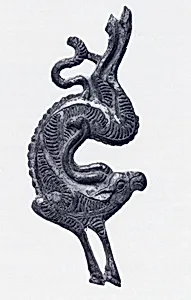
鎏金奔羊紋青銅牌飾|Plaque in the Shape of an Ibex
Unknown Artist
3rd–1st century BCE
Medium
Gilt bronze
Dimensions
H. 3 1/4in. (8.3 cm); W. 1 3/4 in. (4.4 cm)
Classification
Metalwork
Culture
North China
Department
Asian Art
Museum
Metropolitan Museum of Art, New York, NY
Credit
Gift of Ernest Erickson Foundation, 1985
Accession Number
1985.214.79
Rights
Public Domain
Tags
Art Historical Context
This exquisite gilt bronze plaque, shaped as a dynamic running ibex, hails from North China during the 3–1st century BCE turbulent era spanning the late Warring States period into the early Han dynasty. just 3¼ inches high and 1¾ inches wide, this delicate metalwork piece (on view in the Metropolitan Museum of Art's Asian Art department captures the wild grace of the ibex, a mountain goat symbolizing agility and the rugged northern steppes. Likely used as a decorative ornament for belts, horse gear, or clothing, it reflects the cultural exchanges along China's northern frontiers, where nomadic influences blended with local traditions. Crafted from bronze and enhanced with gilding—a sophisticated technique involving mercury-gold amalgam fired onto the surface—the plaque gleams with a luxurious golden sheen that would have signified wealth and status. The intricate casting reveals masterful attention to anatomical detail: the ibex's arched neck, flared horns, and taut muscles evoke motion frozen in time, showcasing the era's advanced lost-wax or piece-mold methods in metalwork. In North Chinese art, such motifs highlight humanity's fascination with the untamed wilderness, bridging settled agrarian societies and steppe nomads. Donated by the Ernest Erickson Foundation in 1985, this rare survivor offers a glimpse into ancient craftsmanship and the vibrant animal iconography that adorned daily life.