
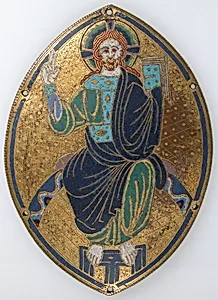
Plaque with Christ Blessing
Unknown Artist
ca. 1190–1200
Medium
Copper: engraved, stippled, gilt; champlevé enamel: dark, medium, and light blue; mauve, turquoise, green, yellow, red, and white.
Dimensions
Overall: 6 3/4 x 4 3/4 x 1/8 in. (17.1 x 12.1 x 0.3 cm)
Classification
Enamels-Champlevé
Culture
French
Department
Medieval Art
Museum
Metropolitan Museum of Art, New York, NY
Credit
Gift of J. Pierpont Morgan, 1917
Accession Number
17.190.759
Rights
Public Domain
Art Historical Context
This exquisite *Plaque with Christ Blessing*, crafted in France around 1190–1200, captures the spiritual fervor of the High Middle Ages. Depicting Christ in a gesture of benediction, the small plaque (just 6¾ x 4¾ inches) likely served as a devotional—perhaps adorning a portable altar, cover, or reliquary personal piety or liturgical use. Produced during the Gothic era's early stirrings, it reflects the era's emphasis on divine grace and intricate religious iconography, when such enamels were prized across Europe for their luminous beauty. The artwork showcases masterful champlevé enamel technique, a hallmark of medieval French metalwork. Artisans engraved and stippled a copper base, applied gilding for radiance, then carved channels filled with vibrant enamels in shades of blue, mauve, turquoise, green, yellow, red, and white. Fired to fuse the powdered glass, this method created durable, jewel-like colors that have endured for over 800 years, symbolizing heavenly light and eternal truths. A gift to The Metropolitan Museum of Art from J. Pierpont Morgan in 1917, this rare survivor highlights the technical innovation and cultural devotion of 12th-century enamelers, offering visitors a tangible glimpse into medieval faith and artistry.