
Plaque with Saint John the Baptist
Unknown Artist
ca. 1400
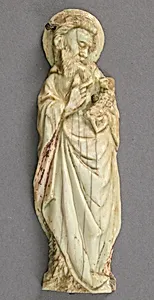
Medium
Ivory, traces of paint & gilding
Dimensions
Overall: 3 5/8 x 1 1/8 x 1/4 in. (9.2 x 2.8 x 0.7 cm)
Classification
Ivories
Culture
French
Department
Medieval Art
Museum
Metropolitan Museum of Art, New York, NY
Credit
The Friedsam Collection, Bequest of Michael Friedsam, 1931
Accession Number
32.100.210
Rights
Public Domain
Art Historical Context
This exquisite ivory plaque, dating to around 1400 and crafted by an unknown French artist, depicts Saint John the Baptist, the prophet and forerunner of Christ. Measuring just 3⅝ × 1⅛ inches, its petite scale suggests it was designed for intimate, personal devotion—perhaps as part of a diptych, book cover, or private altarpiece during the late Middle Ages. Produced in France amid the Gothic era's artistic flowering, such ivories were prized for their portability and spiritual potency, allowing the faithful to carry sacred imagery close to the heart. Carved with remarkable finesse from elephant ivory, the plaque retains traces of original paint and gilding, which once heightened its lifelike details and divine glow. Medieval ivory carvers, often working in Parisian workshops, mastered low-relief techniques to evoke depth and emotion on thin slabs, transforming humble bone into luminous icons. Saint John, typically shown ascetic and pointing to the Lamb of God, embodies themes of penance and baptism central to Christian life. Housed in the Metropolitan Museum of Art's Medieval Art department as part of The Friedsam Collection (1931), this fragile survivor offers a window into 15th-century piety and craftsmanship, reminding us how art bridged the earthly and eternal in turbulent times.