
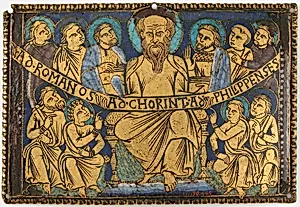
Plaque with Saint Paul and His Disciples
Unknown Artist
ca. 1160–80
Medium
Champlevé enamel, copper
Dimensions
Overall: 3 3/8 x 4 15/16 x 1/16 in. (8.5 x 12.6 x 0.2 cm)
Classification
Enamels-Champlevé
Culture
British (?)
Department
Medieval Art
Museum
Metropolitan Museum of Art, New York, NY
Credit
Gift of J. Pierpont Morgan, 1917
Accession Number
17.190.445
Rights
Public Domain
Tags
Art Historical Context
This exquisite *Plaque with Saint Paul and His Disciples created around 1160–80, captures a pivotal moment in Christian iconography: the apostle Paul preaching to his followers. Measuring just 3⅜ × 4⅞ inches, this tiny copper plaque, possibly of British origin, exemplifies the artistry of the Romanesque period in medieval Europe. Housed in the Metropolitan Museum Art's Medieval Art departmentthanks to a 1917 gift from J. Pier Morgan—it invites visitors to marvel at its intimate scale and spiritual depth. The plaque's medium, champlevé enamel, was a hallmark technique of the 12th century. Art carved shallow channels into the copper base, filled them with powdered glass enamels in vibrant colors, and fired the piece to fuse the layers into a durable, gem-like surface. This method allowed for bold outlines and vivid hues, making religious scenes like this one portable and luminous for altars, reliquaries, or personal devotion. Though the artist remains unknown, the work reflects the era's emphasis on biblical narratives to inspire faith amid a turbulent age of Crusades and monastic reform. Its uncertain British attribution hints at regional enamel traditions rivaling those of Limoges, underscoring how such objects bridged sacred storytelling and technical innovation across medieval Christendom. A true treasure for pondering Paul's enduring legacy!