
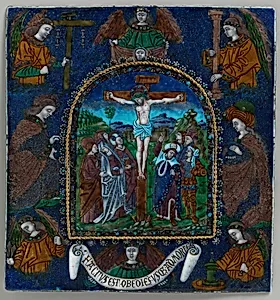
Plaque with the Crucifixion
16th century
Medium
Painted enamel, copper
Dimensions
Overall: 8 3/16 x 7 11/16 x 1/16 in. (20.8 x 19.5 x 0.2 cm) Inset: 4 13/16 x 4 1/8 in. (12.3 x 10.4 cm)
Classification
Enamels-Painted
Culture
French
Department
Medieval Art
Museum
Metropolitan Museum of Art, New York, NY
Credit
Gift of George Blumenthal, 1941
Accession Number
41.100.211a
Rights
Public Domain
Tags
Art Historical Context
This exquisite *Plaque with the Crucifixion*, by the anonymous Master of Orléans Triptych in 16th-century France, captures a pivotal moment in Christian iconography. Crafted in painted enamel on copper, the small plaque (overall 8 3/16 x 7 11/16 in.) features Christ on the cross flanked by angels, mourning women, and a figure of David, blending devotional intensity with Renaissance finesse. Enameling, a technique where finely ground glass colors are fused to metal at high temperatures, allowed for jewel-like vibrancy and durability, making these works prized possessions for private altars or personal piety. Produced during France's Limoges enamel renaissance—a hub for such craftsmanship—this piece reflects the era's fusion of medieval piety and emerging naturalism. The Master's style, known from the Orléans Triptych, emphasizes luminous figures and intricate details, evoking emotional depth in compact form. Now in the Metropolitan Museum of Art's Medieval Art department (gift of George Blumenthal, 1941), it showcases how enamels bridged Gothic traditions and Renaissance humanism, offering visitors a window into 16th-century French religious art's technical mastery and spiritual fervor.