
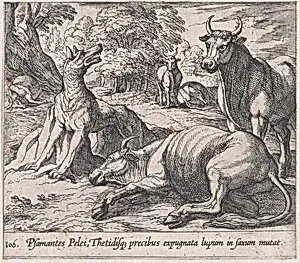
Plate 106: Peleus's Cattle, ad the Sea Wolf Turned to Marble (Psamantes Pelei, Thetidisq precibus expugnata lupum in saxum mutat), from Ovid's 'Metamorphoses'
1606
Medium
Etching
Dimensions
Sheet: 4 1/16 × 4 9/16 in. (10.3 × 11.6 cm)
Classification
Prints
Department
Drawings and Prints
Museum
Metropolitan Museum of Art, New York, NY
Credit
The Elisha Whittelsey Collection, The Elisha Whittelsey Fund, 1951
Accession Number
51.501.3957
Rights
Public Domain
Tags
Art Historical Context
In the vibrant world of 17th-century printmaking, Antonio Tempesta *Plate 106: Peleus's Cattle and the Sea Wolf Turned Marble* (1606) captures a dramatic episode from Ovid's *Metoses*, the ancient Roman poet's epic of mythological transformations. This etching depicts Peleus herd amid trees, threatened by a monstrous sea wolf sent by the nymph Psamathe in revenge for her son's death. Overcome by Thetis's prayers (Peleus's future wife and mother of Achilles), Psamathe petrifies the wolf into marble—a poignant symbol of divine mercy and metamorphosis, themes central to Ovid's narrative. Tempesta, a prolific Italian artist (1555–1630) favored by the Medici court, excelled in etching lively scenes of mythology, animals, and landscapes. This small plate (just over 4 inches square) showcases his masterful technique: fine, energetic lines that convey motion in the cattle's flight and the wolf's eerie stasis, blending Baroque dynamism with Renaissance classicism. Part of a grand series illustrating Ovid, it reflects the era's fascination with antiquity, making complex myths accessible through affordable prints. Housed in the Metropolitan Museum of Art's Elisha Whittelsey Collection, this work highlights printmaking's role in democratizing art, inviting visitors to ponder how a snarling beast frozen in stone echoes timeless tales of vengeance and redemption.
About the Artist
Antonio Tempesta · 1555–1630
Antonio Tempesta (1555–1630), known as 'Il Tempestino,' was a Florentine painter and printmaker whose extraordinary output of approximately 1,700 etchings made him one of the most influential printmakers of the early Baroque period. Born in Florence and trained under Santi di Tito and the Flemish master Joannes Stradanus, he enrolled in the Accademia del Disegno in 1576 before relocating to Rome i...