
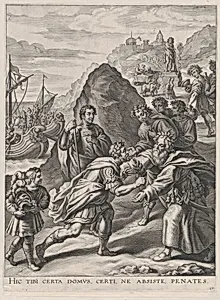
Plate 17: Aeneas welcomed by King Euandrus in Italy; from Guillielmus Becanus's 'Serenissimi Principis Ferdinandi, Hispaniarum Infantis...'
Medium
Engraving
Dimensions
Sheet (Trimmed): 14 3/4 × 10 13/16 in. (37.5 × 27.5 cm)
Classification
Prints|Prints-Fete|Ornament & Architecture
Department
Drawings and Prints
Museum
Metropolitan Museum of Art, New York, NY
Credit
The Elisha Whittelsey Collection, The Elisha Whittelsey Fund, 1951
Accession Number
51.501.7417
Rights
Public Domain
Tags
Art Historical Context
This 1636 engraving, Plate 17 from Guillielmus Becanus’s celebratory volume honoring Ferdinand, Spanish Infante, captures a pivotal moment from Virgil’s Aeneid. It shows the Trojan hero Aeneas being welcomed by King Evander upon his arrival in Italy, a scene rich with themes of hospitality, destiny, and the founding of Rome. Created by engravers Johannes Meursius and Cornelis Galle I, the print belongs to a tradition of festival books that blended classical mythology with contemporary political pageantry. As an engraving on paper, the work exemplifies the medium’s power in the seventeenth century to circulate intricate images widely. Fine lines and careful shading allow for detailed renderings of figures, boats, and architectural elements, reflecting the ornamental and festive character noted in its classification. The trimmed sheet, measuring roughly 14¾ by 10⅞ inches, preserves a lively composition featuring kings, attendants, and youthful figures that would have resonated with viewers familiar with both ancient epics and Habsburg court spectacles. Housed in the Metropolitan Museum’s Department of Drawings and Prints, this piece offers modern audiences a window into how Baroque artists merged literary heritage with visual storytelling to glorify rulers.
About the Artist
Johannes Meursius|Cornelis Galle I · 1600–1699
**Johannes Meursius** was a Flemish publisher and printmaker active in Antwerp from around 1620 to 1647. Little is known of his early life or training, but he established himself as a key figure in the production of high-quality engravings during the Baroque period. Working in the vibrant artistic center of Antwerp, he commissioned and published series of prints that captured elaborate public spec...