
Plate
1881
Medium
Bone china
Dimensions
Diameter: 9 1/2 in. (24.1 cm)
Classification
Ceramics-Porcelain
Culture
British, Stoke-on-Trent, Staffordshire
Department
European Sculpture and Decorative Arts
Museum
Metropolitan Museum of Art, New York, NY
Credit
Gift of Robert L. Isaacson, 1989
Accession Number
1989.311
Rights
Public Domain
Tags
Art Historical Context
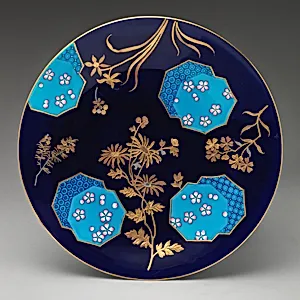
This elegant bone china plate, produced by the renowned Minton manufactory in Stoke-on-Tr, Staffordshire, in 1, exemplifies the pinnacle of Victorian British ceramics. Measuring 9½ inches in diameter, itails from a golden age of industrial pottery, when Minton—founded in 1793—dominated the market with its innovative techniques and luxurious designs. Bone china, a translucent porcelain strengthened by bone ash, allowed for delicate thinness and durability, making it ideal for fine dining ware prized by the British upper class. The plate's floral motifs, a hallmark of Minton's Aesthetic Movement influences, reflect the era's obsession with nature-inspired ornamentation. These intricate patterns, often hand-painted or transfer-printed, blended artistry with mass production, showcasing Staffordshire's role as the heart of England's pottery industry. Mintons supplied royalty and exported worldwide, elevating everyday objects to status symbols. Today, housed in the Metropolitan Museum of Art's European Sculpture and Decorative Arts department (gift of Robert L. Isaacson, 1989), this piece invites us to appreciate how 19th-century innovation transformed ceramics into high art, bridging utility and beauty.
About the Artist
Minton(s) · 1793–2001
Minton is among the most distinguished names in the history of British ceramics, a firm whose two and a quarter centuries of production encompass everything from blue transfer-printed earthenwares to the most rarefied decorative porcelain of the Victorian age. The company was founded in 1793 by Thomas Minton (1765–1836) in Stoke-upon-Trent, Staffordshire — the heart of England's pottery industry. ...