
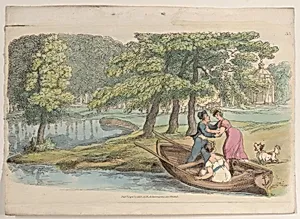
Plate 35, from "World in Miniature"
Medium
Hand-colored etching
Dimensions
Sheet: 6 13/16 × 9 9/16 in. (17.3 × 24.3 cm)
Classification
Prints
Department
Drawings and Prints
Museum
Metropolitan Museum of Art, New York, NY
Credit
Rogers Fund, 1917
Accession Number
17.49.2(35)
Rights
Public Domain
Tags
Art Historical Context
Step into the whimsical world of Regency-era satire with *Plate 35* from Thomas Rowlandson's *World in Miniature*, published by Rudolph Ackermann in London in1816. Rowlandson, a master caricaturist renowned for his lively, exaggerated depictions of British society, collaborated frequently with Ackermann, whose innovative printshop produced vibrant series capturing everyday life. This hand-colored etching, measuring just 6 13/16 × 9 9/16 inches, exemplifies the duo's talent for transforming small-scale prints into accessible windows on 19th-century culture. The scene buzzes with energy: men and women mingle along a riverbank, accompanied by playful dogs, while boats dot the water—likely poking fun at leisurely outings, social faux pas, or the era's boating craze on the Thames. Hand-coloring, applied by skilled artisans after etching, adds vivid hues and depth, making these affordable prints popular collectibles that brought humor into middle-class homes. Housed in the Metropolitan Museum of Art's Drawings and Prints department (Rogers Fund, 1917), this piece highlights Rowlandson's satirical bite and Ackermann's technical prowess, offering a delightful glimpse into Georgian Britain's spirited social scene.
About the Artist
Thomas Rowlandson|Rudolph Ackermann, London · 1756–1827
Thomas Rowlandson (1757–1827) was an English artist and caricaturist whose satirical watercolors and prints captured the social life of Georgian Britain with unparalleled wit and technical mastery. Alongside James Gillray, he is recognized as one of the greatest British graphic artists, and his distinctive flowing line and keen observations have made his work integral to understanding late 18th an...