
Plate
Unknown Artist
16th–17th century
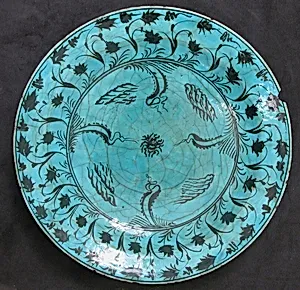
Medium
Stonepaste; painted in black under turquoise glaze
Dimensions
Diam. 13 1/2 in. (34.3 cm)
Classification
Ceramics
Department
Islamic Art
Museum
Metropolitan Museum of Art, New York, NY
Credit
Theodore M. Davis Collection, Bequest of Theodore M. Davis, 1915
Accession Number
30.95.167
Rights
Public Domain
Art Historical Context
This elegant plate from the 16th–17th century exemplifies the refined ceramics of the Islamic world, likely produced in Persia during the Safavid era. Crafted from stonepaste—a composite material of quartz, clay, and frit developed by Islamic potters to mimic the translucency of Chinese porcelain—it measures 13½ inches in diameter, ideal for serving dishes in grand households. Now housed in the Metropolitan Museum of Art's Islamic Art Department, it entered the collection through the bequest of Theodore M. Davis in 1915. The artwork's technique is particularly noteworthy: black pigments were painted directly onto the unfired stonepaste body, then coated with a vibrant turquoise glaze and fired at high temperatures. This underglaze method ensured durable, vivid decoration that resisted wear, showcasing potters' mastery of color and chemistry. Turquoise, symbolizing paradise and spirituality in Islamic culture, was a favored hue, evoking the natural beauty of lapis lazuli and evoking luxury. Such plates bridged utility and artistry, adorning dining tables of the elite while reflecting broader cultural exchanges along the Silk Road. Though the artist remains unknown, this piece invites us to appreciate the anonymous ingenuity that defined Islamic ceramic innovation.