
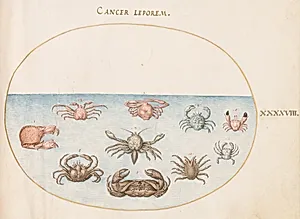
Plate 48: Ten Crabs
c.1575/1590s
Medium
watercolor and gold paint on parchment
Dimensions
page size (approximate): 14.3 x 18.4 cm (5 5/8 x 7 1/4 in.)
Classification
Drawing
Department
CG-E
Museum
National Gallery of Art, Washington, D.C.
Credit
Gift of Mrs. Lessing J. Rosenwald
Accession Number
1987.20.7.49
Rights
Public Domain
Art Historical Context
In the late 16th, Flemish artist Joris Hoefagel (1542–1600) captured the intricate beauty of the natural world with unparalleled precision in *Plate 48: Ten Crabs* (c. 1575/1590s). This delicate watercolor and gold paint on parchment, measuring just 14.3 x 18.4 cm, exemplifies Hoefnagel's role as a pioneering miniaturist during the Northern Renaissance. Working for Habsburg courts, including Emperor Rudolf II in Prague, he blended scientific observation with artistic virtuosity, contributing to the era's fascination with natural history and *wunderkammern* (cabinets of curiosities). Hoefnagel's ten crabs—depicted in vivid detail from multiple angles—showcase his mastery of realism and texture. The translucent shells, spindly legs, and subtle iridescence are heightened by touches of gold paint, evoking the shimmer of life underwater. Rendered on fine parchment, a medium rooted in illuminated manuscripts, the work bridges medieval traditions and emerging empiricism, influencing later still-life genres. Today, this gem from the National Gallery of Art's collection (gift of Mrs. Lessing J. Rosenwald) invites us to marvel at nature's diversity. Imagine peering through a jeweler's lens at these armored creatures—Hoefnagel's eye for the minuscule reminds us how art can illuminate the wonders hidden in plain sight.
About the Artist
Joris Hoefnagel · 1542–1600
Joris Hoefnagel, also known as Georg Hoefnagel, was born in 1542 in Antwerp to Jacob Hoefnagel, a prosperous diamond and luxury goods dealer, and Elisabeth Vezelaer, daughter of the Antwerp mint master. Intended for the family trade, he received a humanistic education, mastering languages, poetry, and music, but pursued art as a self-taught draftsman and miniaturist, receiving his first lessons fr...