
Plate
Unknown Artist
1830–45
Medium
Lacy pressed glass
Dimensions
Diam. 6 1/8 in. (15.6 cm)
Classification
Plate
Culture
American
Department
The American Wing
Museum
Metropolitan Museum of Art, New York, NY
Credit
Gift of Mrs. Charles W. Green, in memory of Dr. Charles W. Green, 1951
Accession Number
51.171.85
Rights
Public Domain
Art Historical Context
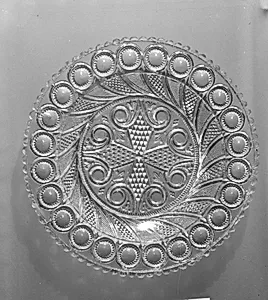
This delicate Lacy pressed glass plate, crafted in America between 1830 and1845, exemplifies the ingenuity of early industrial glassmaking. Measuring just 6⅛ inches in diameter, was designed for everyday use—perhaps serving desserts or small confections—yet its intricate, lace-like patterns elevated it to a status symbol for the growing middle class. The "lacy" effect, achieved through finely detailed molds, mimicked the elegance of handmade lace or cut glass, making luxury accessible without the high cost of traditional techniques. Lacy pressed glass emerged during a pivotal era in American manufacturing, as factories like those in New England and the Midwest adopted steam-powered presses around the 1820s–30s. This innovation allowed for rapid production of ornate tableware, democratizing beauty in homes across the young republic. Unlike blown glass, pressing created uniform, durable pieces with textured motifs—often floral or geometric—that caught the light beautifully, reflecting the era's fascination with pattern and refinement amid rapid urbanization. Housed in The Metropolitan Museum of Art's American Wing, this plate, a gift honoring Dr. Charles W. Green, stands as a quiet testament to anonymous artisans' skill. It invites us to appreciate how everyday objects embodied national pride and creativity in antebellum America.