
Plate
Unknown Artist
ca. 1830
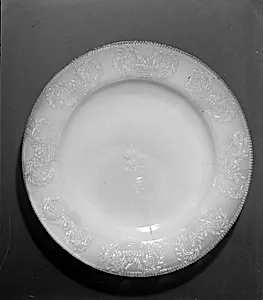
Medium
Lacy pressed opalescent and opaque white glass
Dimensions
Diam. 6 1/8 in. (15.6 cm)
Classification
Plate
Department
The American Wing
Museum
Metropolitan Museum of Art, New York, NY
Credit
Gift of Mrs. Charles W. Green, in memory of Dr. Charles W. Green, 1951
Accession Number
51.171.101
Rights
Public Domain
Art Historical Context
This delicate plate, crafted around 1830 by an unknown American artist, exemplifies the ingenuity of early 19th-century glassmaking in the United States. Measuring just 6 1/8 inches in diameter, it features a lacy pressed design in opalescent and opaque white glass—a shimmering medium that catches the light with iridescent hues, evoking the elegance of fine lacework. Housed in The Metropolitan Museum of Art's American Wing, it was generously gifted in 1951 by Mrs. Charles W. Green in memory of her husband, Dr. Charles W. Green. The "lacy" pattern refers to a popular pressing technique pioneered in American factories during the 1820s and 1830s. Molten glass was forced into intricately molded iron dies, creating affordable, mass-produced tableware that mimicked the luxury of hand-cut European crystal. Opalescent glass, with its milky translucency, added a touch of whimsy and sophistication, making such pieces desirable for middle-class homes. As a snapshot of America's burgeoning industrial age, this plate highlights how glassmakers democratized beauty, blending artistry with innovation. Visitors can appreciate its subtle glow under gallery lights, a testament to the era's craft revival and the enduring charm of everyday objects.