
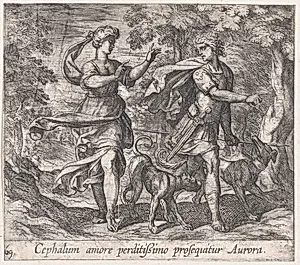
Plate 69: Cephalus and Aurora (Cephalum amore perditißimo prosequitar Aurora), from Ovid's 'Metamorphoses'
1606
Medium
Etching
Dimensions
Sheet: 4 in. × 4 1/2 in. (10.2 × 11.5 cm)
Classification
Prints
Department
Drawings and Prints
Museum
Metropolitan Museum of Art, New York, NY
Credit
The Elisha Whittelsey Collection, The Elisha Whittelsey Fund, 1951
Accession Number
51.501.3920
Rights
Public Domain
Tags
Art Historical Context
Behold Plate 69 from Antonio Tempesta's enchanting series of etchings illustrating Ovid's *Metamorphoses*, published in 1606. This intimate 4 x 4½-inch work captures the mythological moment when Aurora, the radiant goddess of dawn, ardently pursues the handsome huntsman Cephalus. Drawn from Book 7 of Ovid's epic poem, the scene depicts Aurora's unrequited passion—"Cephalum amore perditissimo prosequitur Aurora" (Aurora pursues Cephalus with the most lost love)—as he remains devoted to his wife, Procris. Tempesta, a prolific Florentine artist favored by the Medici court, masterfully distilled this tale of desire and fidelity into a compact format perfect for lavish illustrated books. Tempesta's etching technique shines here, with its precise, fluid lines evoking movement and emotion in a tiny space. Dogs, symbols of the hunt, bound alongside the figures, adding dynamism and tying into Cephalus's identity as a skilled tracker. As a leading Baroque-era printmaker, Tempesta produced over 2,000 etchings, blending classical mythology with vivid naturalism, making ancient stories accessible to 17th-century collectors. Housed in the Metropolitan Museum of Art's Drawings and Prints department through The Elisha Whittelsey Collection, this plate invites us to ponder timeless themes of love's pursuit amid Renaissance revival of Greco-Roman lore. A gem for mythology enthusiasts!
About the Artist
Antonio Tempesta · 1555–1630
Antonio Tempesta (1555–1630), known as 'Il Tempestino,' was a Florentine painter and printmaker whose extraordinary output of approximately 1,700 etchings made him one of the most influential printmakers of the early Baroque period. Born in Florence and trained under Santi di Tito and the Flemish master Joannes Stradanus, he enrolled in the Accademia del Disegno in 1576 before relocating to Rome i...