
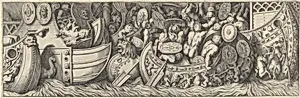
Plate 7: a battle taking place between men in boats
Medium
Etching
Dimensions
Sheet: 6 9/16 in. × 18 in. (16.7 × 45.7 cm)
Classification
Prints
Department
Drawings and Prints
Museum
Metropolitan Museum of Art, New York, NY
Credit
Bequest of Phyllis Massar, 2011
Accession Number
2012.136.911.7
Rights
Public Domain
Tags
Art Historical Context
Welcome visitors to Plate 7: *A Battle Taking Place Between Men in*, a dynamic etching from the late 17th century (. 1660–90), now housed in the Metropolitan Museum of Art Drawings and Prints department. This print, measuring 6 9/16 × 18 inches, was created by Pietro Santi Bartoli after designs by the Renaissance master Polidoro da Caravaggio (. 1499–1543), with publication by Giovanni Giacomo de Rossi. It captures a chaotic naval clash filled with muscular male nudes, soldiers, and boats, evoking the raw energy of ancient battles. Polidoro, a pupil of Raphael, gained fame for his innovative facade paintings on Roman buildings, drawing from classical motifs like those in ancient frescoes—often featuring nude figures in dramatic combat. Bartoli's etching technique, a precise intaglio method using acid to bite lines into a metal plate, allowed for intricate details and widespread reproduction, making these Renaissance visions accessible to collectors across Europe. De Rossi's Roman printshop was a hub for such scholarly reproductions, bridging antiquity and the Baroque era. This bequest from Phyllis Massar in 2011 highlights the print's enduring appeal: a testament to how 17th-century artists revived classical heroism through technical innovation, inviting us to ponder the timeless drama of human conflict on the waves.
About the Artist
Pietro Santi Bartoli|Polidoro da Caravaggio|Giovanni Giacomo De Rossi · 1615–1700
Pietro Santi Bartoli, born in Perugia in 1635, emerged as a pivotal figure in the Roman antiquarian revival of the late seventeenth century. Relocating to Rome as a youth, he initially pursued painting, studying under the French artist Jean Lemaire—known as "Le Petit Lemaire"—and later under the esteemed Nicolas Poussin, whose classical rigor profoundly shaped his early approach. Though traces of ...