
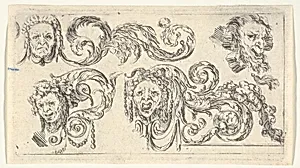
Plate 8: four grotesque heads with scrollwork, from 'Friezes, foliage, and grotesques' (Frises, feuillages et grotesques)
ca. 1638–43
Medium
Etching
Dimensions
Sheet: 2 3/8 × 4 1/4 in. (6.1 × 10.8 cm)
Classification
Prints|Ornament & Architecture
Department
Drawings and Prints
Museum
Metropolitan Museum of Art, New York, NY
Credit
Bequest of Phyllis Massar, 2011
Accession Number
2012.136.101.8
Rights
Public Domain
Tags
Art Historical Context
Stefano della Bella, a prolific 17th-century Italian et renowned for his intricate ornamental designs, created *Plate 8: four heads with scrollwork* around 1638–43 as part of his series *Friezes, foliage, andques* (*Frises, feuill et grotesques*). Working primarily in Florence and Paris, della Bella drew inspiration from the fantastical motifs revived during the Renaissance, echoing ancient Roman decorations rediscovered in sites like Nero's Domus Aurea. These prints were highly sought after by architects, designers, and collectors for their utility in spreading decorative ideas across Europe. This small etching (just 2 3/8 × 4 1/4 inches) showcases four exaggerated male heads—grotesque in their whimsical, distorted features—intertwined with flowing scrollwork. Grotesques, blending human forms with foliage and fantasy, were a hallmark of Mannerist and early Baroque ornament, symbolizing the playful excesses of imagination. Della Bella's etching technique, with its precise needle work on a copper plate bathed in acid, allowed for delicate lines and textures that captured the lively interplay of forms, making it ideal for pattern books. Housed in the Metropolitan Museum of Art's Drawings and Prints department through the bequest of Phyllis Massar, this plate highlights the era's fascination with ornamental prints as both art and practical tools, bridging fine art with decorative crafts. Visitors will appreciate its compact charm, a window into 17th-century design ingenuity.
About the Artist
Stefano della Bella · 1610–1664
Stefano della Bella (1610-1664) was one of the most prolific and versatile printmakers of the Italian Baroque period, leaving behind 1,052 prints and several thousand drawings that captured the vivid essence of 17th-century European life. Born in Florence on May 18, 1610, to a family of artists, he trained initially as a goldsmith before studying painting under Cesare Dandini and etching under Rem...